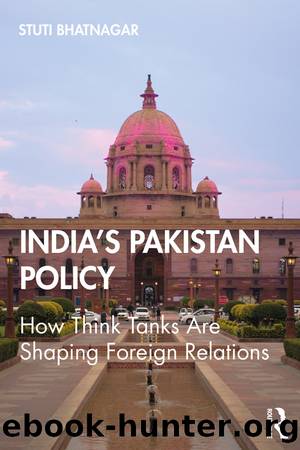
India's Pakistan Policy: How Think Tanks Are Shaping Foreign Relations by Stuti Bhatnagar
Author:Stuti Bhatnagar [Bhatnagar, Stuti]
Language: eng
Format: epub
Tags: International Relations, Political Science, General, Diplomacy
ISBN: 9781000170092
Google: DjLvDwAAQBAJ
Goodreads: 52664546
Publisher: Taylor & Francis
Published: 2020-08-09T00:00:00+00:00
5
NON-GOVERNMENT POLICY THINK TANKS
Government think tanks examined in the previous chapter did not lack financial resources and enjoyed easy access to policymakers. The discursive interactions therefore remained strong and substantive. While their ideational independence could be questioned and there was a similar political narrative, policy inputs were clearly visible due to direct connections with the government. Both examples of coordinative and communicative discourse can be found in their engagement with foreign policy issues. On the other end of the spectrum are non-government think tanks that do not depend primarily on government sources for funding alone but managed to establish networks with international funding organisations. While funding has been diversified, this chapter seeks answers to other crucial questions: did their relative independence from government funding enable independent thinking? how did they engage with formal policy-making mechanisms in India? what was the level of access to policymakers? Were non-government think tanks conditioned by the research agendas of donor organisations, particularly on IndiaâPakistan relations?
As in the previous chapter, this chapter also emphasises the role of intellectual elites in generating public opinion and interacting with policy-making mechanisms, particularly on relations with Pakistan. This chapter and the next are linked. While the first part focuses the attention on some of the big players in this category that include the Observer Research Foundation (ORF), the Centre for Policy Research (CPR), the Vivekananda International Foundation (VIF) and the India Foundation (IF) with broad research agendas, in the second part the focus is on non-government think tanks with research agendas specifically focused on peacebuilding and reconciliation. These include the Institute of Peace and Conflict Studies (IPCS), the Delhi Policy Group (DPG), the Women in Security, Conflict Management and Peace (WISCOMP) and the Centre for Dialogue and Reconciliation (CDR).
It was argued in the previous chapter that the creation of think tanks and support to intellectual elites was an attempt by the government of India to institutionalise consensus on policy directions. This was reflective of the Gramscian notion of state spirit where intellectual elites at government think tanks created consensus for government policy on Pakistan, highlighting dominant government narratives focused on national security and strategic strength. This chapter takes this argument further through an analysis of the intellectual membership and policy discourse of non-government think tanks. With relative freedom from government funding brought about by Indiaâs liberalisation process, these think tanks were able to expand the scope of ideas on Pakistan. Yet, access to funding was also enabled by government support and was a reflection of Indiaâs expanding international interests and the need to enhance the bureaucracyâs capacity in dealing with new security issues.
The tools provided by DI have been useful to highlight the interactive processes that have enabled the ORF, the VIF, the IF and the CPR to be actors within the foreign policy process. The involvement of elites in government committees and specific project funding aimed at providing policy expertise in areas where the MEA lacks capacity are indications of their interactions and the creation of a âdiscursive sphere.
Download
This site does not store any files on its server. We only index and link to content provided by other sites. Please contact the content providers to delete copyright contents if any and email us, we'll remove relevant links or contents immediately.
| Anthropology | Archaeology |
| Philosophy | Politics & Government |
| Social Sciences | Sociology |
| Women's Studies |
Cecilia; Or, Memoirs of an Heiress — Volume 1 by Fanny Burney(32561)
The Great Music City by Andrea Baker(32021)
Cecilia; Or, Memoirs of an Heiress — Volume 2 by Fanny Burney(31958)
Cecilia; Or, Memoirs of an Heiress — Volume 3 by Fanny Burney(31944)
We're Going to Need More Wine by Gabrielle Union(19051)
All the Missing Girls by Megan Miranda(16042)
Pimp by Iceberg Slim(14517)
For the Love of Europe by Rick Steves(14154)
Bombshells: Glamour Girls of a Lifetime by Sullivan Steve(14079)
Talking to Strangers by Malcolm Gladwell(13375)
Norse Mythology by Gaiman Neil(13372)
Fifty Shades Freed by E L James(13245)
Mindhunter: Inside the FBI's Elite Serial Crime Unit by John E. Douglas & Mark Olshaker(9346)
Crazy Rich Asians by Kevin Kwan(9295)
The Lost Art of Listening by Michael P. Nichols(7507)
Enlightenment Now: The Case for Reason, Science, Humanism, and Progress by Steven Pinker(7315)
The Four Agreements by Don Miguel Ruiz(6767)
Bad Blood by John Carreyrou(6625)
Weapons of Math Destruction by Cathy O'Neil(6283)
